
What percentage of Google searches now show AI Overviews?
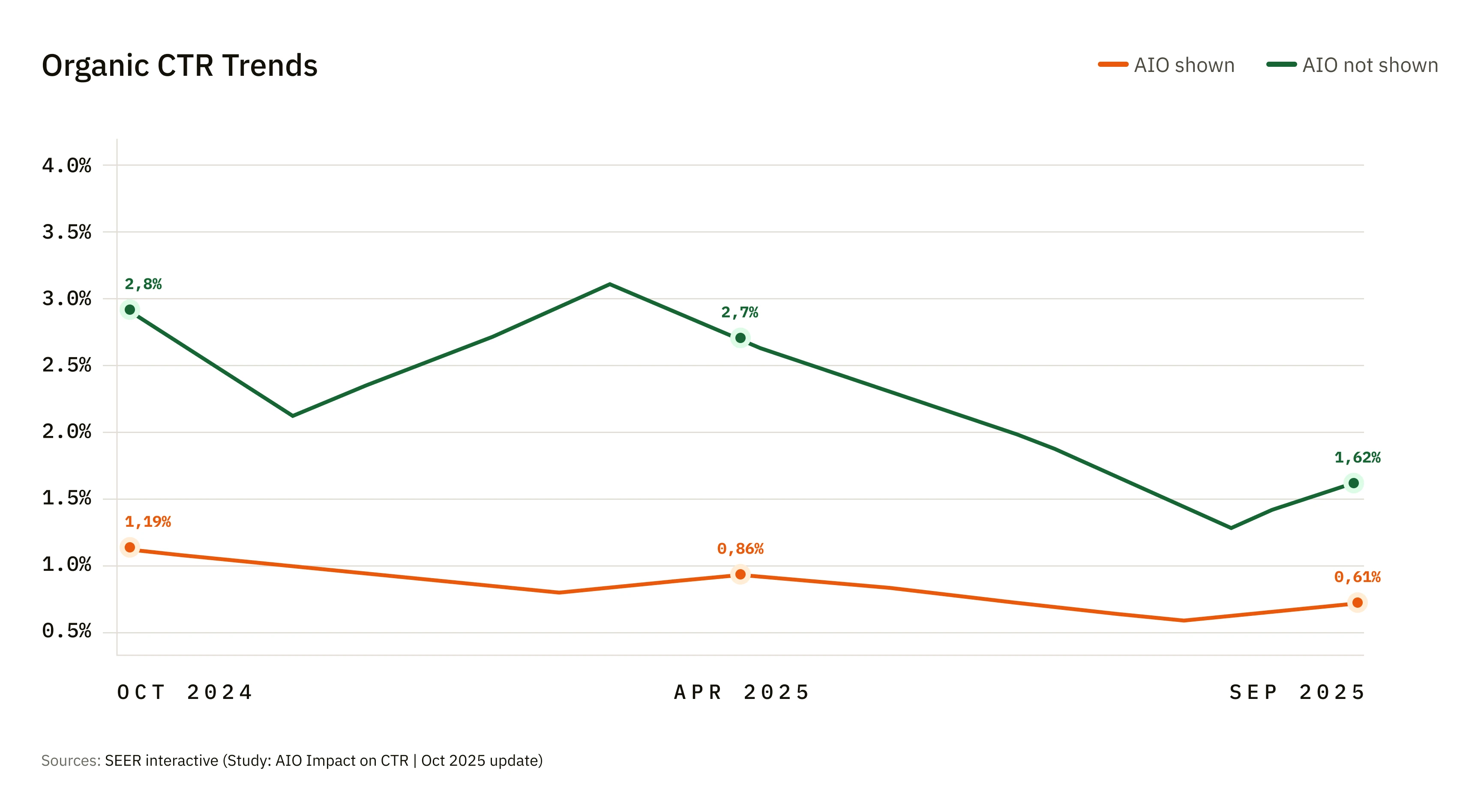
As of November 2025, Google AI Overviews appear in 60% of U.S. searches—double the 30% rate from August 2024. This isn't a gradual feature rollout. It's a fundamental transformation in how search results are displayed and consumed.
| Metric | August 2024 | November 2025 | Change |
|---|---|---|---|
| AI Overview appearance rate | 30% | 60% | +100% |
| Organic CTR with AI Overview | 1.41% | 0.64% | -54.6% |
| User engagement with AI box | Medium | Primary | Dominant |
When AI Overviews appear, users read answers directly in the interface and rarely scroll to traditional organic results. This is the moment SEO stopped being about Google as we knew it.

How much does organic click-through rate drop when AI Overviews appear?
Organic CTR collapses from 1.41% to just 0.64% when AI Overviews are present—a 54.6% decline. Users consume answers directly in the AI-generated summary without clicking through to source websites.
Traditional search behavior (no AI Overview):
- User sees 10 blue links
- Clicks position 1-3 for answers
- Average CTR: 1.41% for typical results
AI Overview search behavior:
- User sees AI-generated summary first
- Reads complete answer in the interface
- Average CTR: 0.64% (when they click at all)
The value equation has shifted. Rankings still matter for discovery, but citations within AI Overviews determine visibility. Learn how Wrodium improves AI search visibility by optimizing for citation, not just ranking.
What's the difference between being ranked vs. being cited by AI?
AI doesn't rank websites—it selects sources to quote. This is fundamentally different from traditional search ranking algorithms.
| Traditional Ranking (SEO) | AI Citation (AEO/GEO) |
|---|---|
| Position by PageRank, keywords, backlinks | Selection by verifiability, structure, freshness |
| All top 10 results get some visibility | Only 2-5 sources get cited in AI answer |
| Traffic comes from clicks | Authority comes from being quoted |
| Success = organic CTR | Success = citation rate |
Your goal is no longer "rank in top 3." It's "become one of the 2-5 sources AI trusts enough to cite." Our GEO-16 framework identifies the 16 signals that predict AI citation likelihood.
Why does AI ignore my content even though it ranks well on Google?
AI systems skip content that lacks the structural and verifiability signals they require for confident citation. Google ranking measures relevance; AI citation requires quotability.
| Issue | Why AI Skips It | How to Fix |
|---|---|---|
| Stale dates | Content not updated in 6+ months | Add "Reviewed on: YYYY-MM-DD" and update every 60-90 days |
| Missing schema | No structured data for AI to parse | Implement Article, FAQPage, or HowTo schema in JSON-LD |
| Keyword-stuffed writing | Optimized for bots, not comprehension | Rewrite in clear Q&A format with concise answers |
| Buried sources | No citations at bottom | Move citations adjacent to claims (same paragraph) |
| Ambiguous facts | Vague claims without specifics | Use numbers, dates, and attributable statements |
| No canonical URL | Competing duplicates split authority | Set single canonical; consolidate cross-posts |
See how Wrodium keeps content accurate and trustworthy through automated freshness monitoring.
How often should I update content to maintain AI visibility?
Every 60–90 days for high-intent pages. AI crawlers prioritize recently updated content when selecting sources to cite.
| Content Type | Recommended Refresh | Why This Matters |
|---|---|---|
| Product comparisons | Every 30-45 days | Pricing, features change frequently |
| Industry trends/analysis | Every 60 days | Market conditions evolve |
| How-to guides | Every 90 days | Tools update, best practices shift |
| News/current events | Real-time to 7 days | AI heavily weights recency |
Track median days since dateModified as a core KPI. Pages updated within 45 days show 2.3× higher citation rates than pages stale for 90+ days.
What structured data schema do AI systems need to cite my content?
AI systems prioritize three schema types: Article, FAQPage, and HowTo. Match schema to visible content; sync dateModified with "Reviewed on" date; complete required fields (author, publisher); validate monthly with Google's Rich Results Test.
{
  "@context": "https://schema.org",
  "@type": "Article",
  "headline": "Google AI Overviews Now Dominate 60% of Searches",
  "datePublished": "2024-12-01",
  "dateModified": "2025-02-07",
  "author": { "@type": "Person", "name": "Leanid Palkhouski" },
  "publisher": { "@type": "Organization", "name": "Wrodium", "logo": { "@type": "ImageObject", "url": "https://wrodium.com/logo.png" }
  }
}
Learn more in our agencies playbook for GEO and AEO.
What is the difference between AEO and traditional SEO?
AEO (AI Engine Optimization) targets trust and citations from AI systems. SEO targets rankings and traffic from traditional search engines.
| Aspect | Traditional SEO | AEO |
|---|---|---|
| Primary goal | Rank in top 10 | Get cited in AI answers |
| Success metric | Organic traffic, CTR | Citation rate |
| Content structure | Keyword-optimized, backlinks | Q&A format, structured data, adjacent citations |
| Update frequency | Quarterly or when rankings drop | Every 60-90 days |
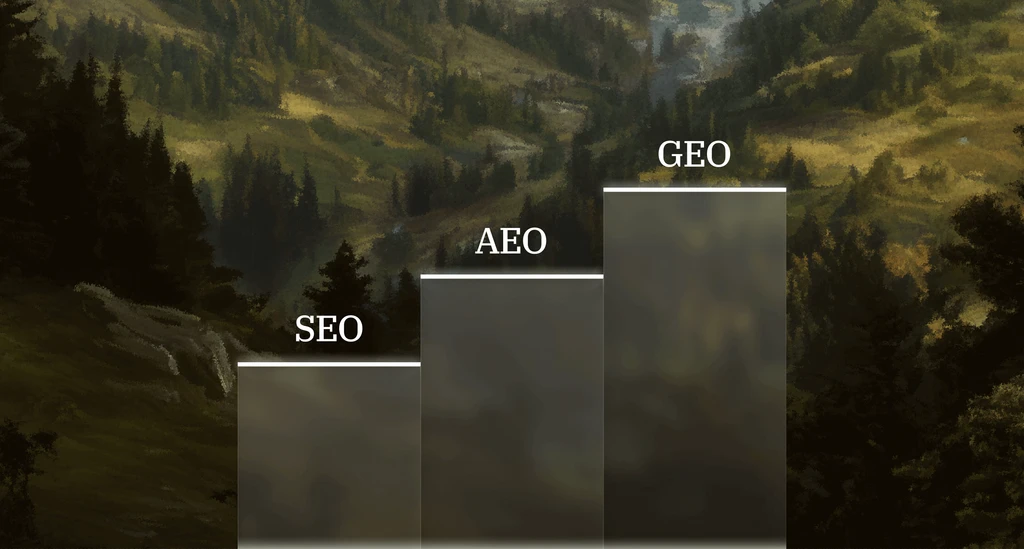
Both matter: SEO gets you discovered. AEO makes you quotable. Understand where Wrodium fits in the SEO → AEO → GEO evolution.
How do I rewrite keyword-optimized content for AI comprehension?
Transform SEO-style content into AI-readable Q&A format: concise answers, specific entities, fact-checkable claims. Front-load value (answer in first 60 words); use entities (names, numbers, dates); provide attribution next to claims; structure with H2 as questions; add comparison tables and FAQ sections. See ChatGPT shopping research for examples.
What metadata do AI systems check before citing content?
AI systems validate: dateModified (sync with visible "Reviewed" date), datePublished, author (real names, not "Admin"), headline (match H1, clear question/statement), publisher (consistent org name + logo). Inconsistent or missing metadata reduces citation probability by 60%+.
How do I test if my content is being cited by AI search engines?
Run manual citation audits monthly. Identify 10-20 high-intent queries; query ChatGPT, Perplexity, Google AI Overviews, Claude, Gemini; record whether you're cited with attribution, paraphrased without attribution, or omitted; calculate Citation Rate = (queries where you're cited / total queries) × 100. Track monthly. Our M&A advisor case study improved from 12% to 61% citation rate in 90 days.
How many times more often do AI-optimized pages get cited compared to traditional SEO?
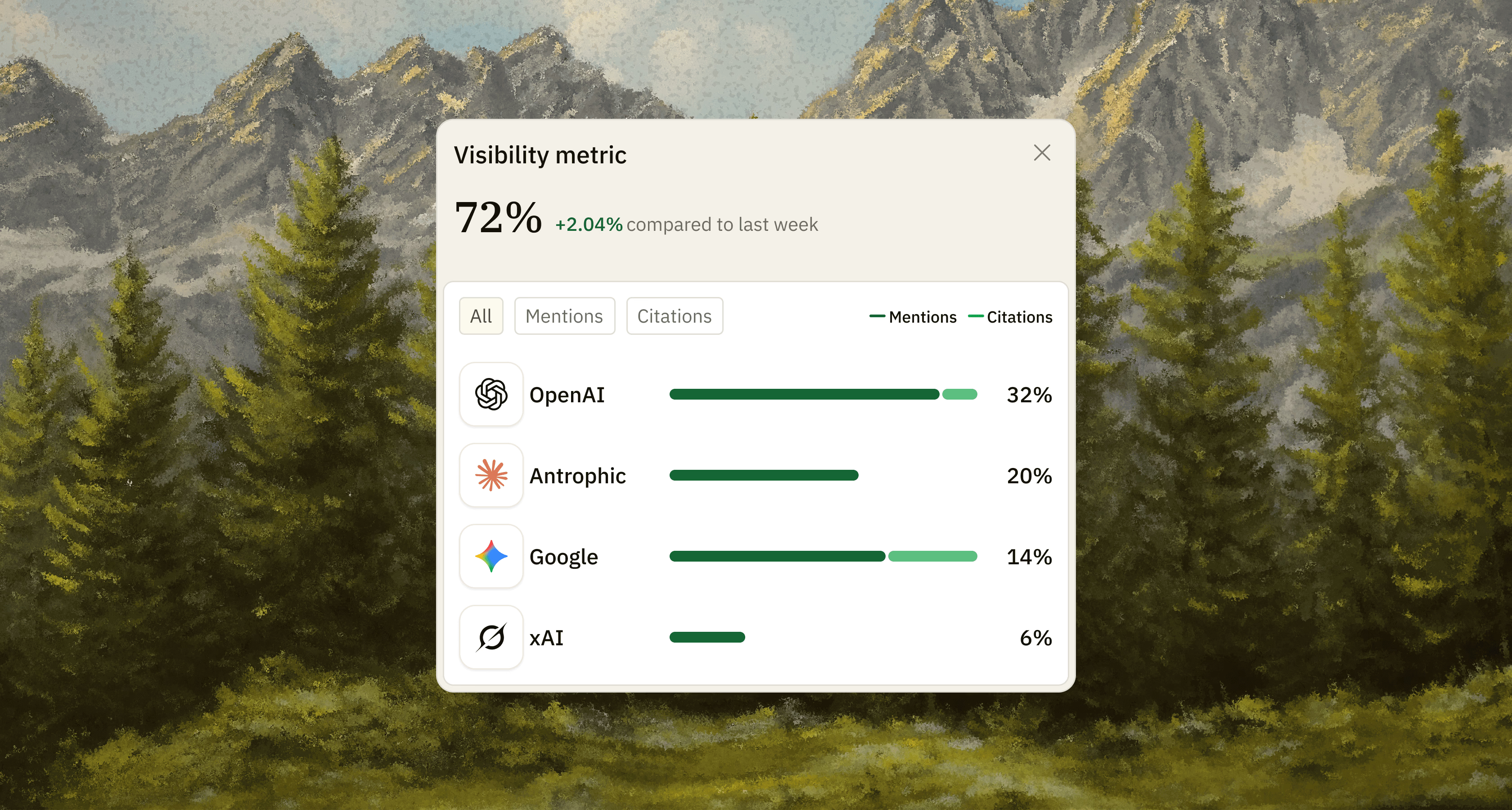
Brands using AI-optimized frameworks are cited 23× more often in AI search results than traditional SEO delivers in organic clicks when AI Overviews appear. Effective visibility through citations ~35% vs. ~0.6% through clicks. Explore how Wrodium transforms content for 40-60% citation rates.
Your New SEO Playbook: 5 Steps to Become AI-Quotable
1. Audit for content staleness — Flag pages >90 days since update; prioritize high-conversion pages.
2. Add structured data (JSON-LD) — Article, FAQPage, HowTo so AI can parse and cite you.
3. Rewrite for AI comprehension — Q&A format, first 60 words answer, citations adjacent to claims.
4. Standardize metadata — dateModified, author, headline, publisher consistent.
5. Test citation presence — Query AI tools with your audience's questions; re-test after 30 days. Follow weekly AI search signals.
Frequently Asked Questions
What is AEO? AEO is optimizing content so AI models can understand, trust, and cite it—structured data, verifiability, comprehension.
How does AEO differ from SEO? SEO targets rankings and traffic; AEO targets trust and citations from AI systems.
Why is structured data essential for AI? Article, FAQPage, HowTo schemas give AI machine-readable context to quote you accurately with attribution.
How does Wrodium help brands get cited by AI? Wrodium automates AEO: freshness monitoring, schema standardization, content structure optimization.
Do I still need traditional SEO if I optimize for AEO? Yes. SEO gets you indexed; AEO makes you quotable. Both work together.
How long for AEO results? 30-60 days for measurable citation rate improvements.
Follow the Series: 30 Days to AI Search Mastery
This is Day 1 of 30 exploring AEO, GEO, and the next evolution of SEO in an AI-driven web. 🚀 Explore the complete 30 Days of AI Mastery series.
Additional Resources: All blog posts · Research & case studies · Contact Wrodium
Reviewed on: 2025-02-07