
TL;DR
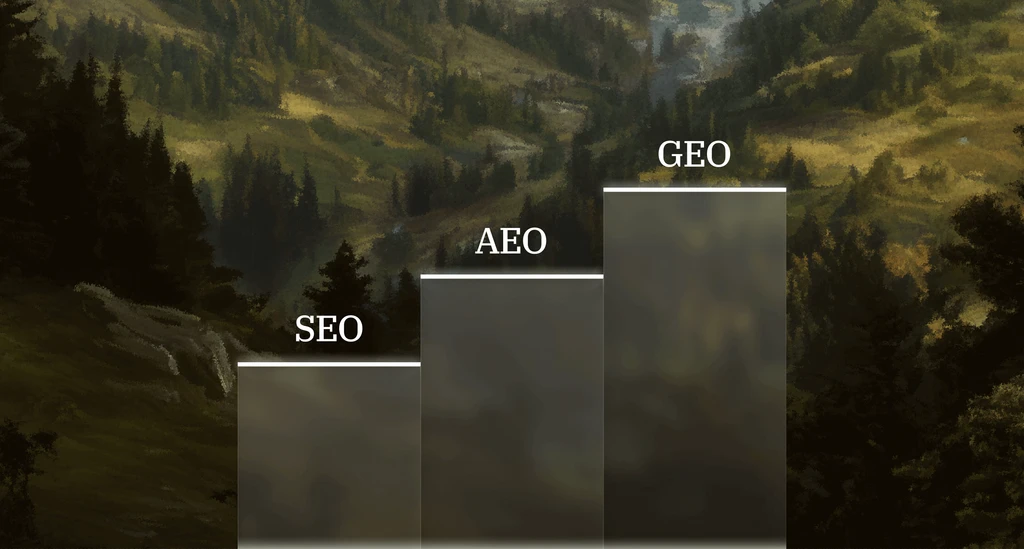
SEO aims to rank helpful pages in classic results. AEO targets answer surfaces with condensed Q→A patterns. GEO ensures AI answer engines can extract and safely cite your claims by adding structure, inline evidence, and freshness—aligned with Google's people-first guidance, FAQ structured data, and AI Overviews.
Historical context: from blue links to answer engines
Early SEO (late 1990s to 2000s)
The web's first era revolved around directories, keyword density, and the breakthrough of link-based authority. As search quality improved, modern SEO emerged: publish helpful content, make sites crawlable, build sensible internal links, and earn trust.
Over time, Google's guidance shifted from what the crawler needs to what people find helpful, formalized in its creating helpful, reliable, people-first content playbook.
The rise of AEO (2010s to early 2020s)
Featured snippets, knowledge panels, and voice assistants changed user expectations: the best result often looked like a direct answer. Answer Engine Optimization emerged to meet this: write concise, high-confidence responses and apply schema that maps questions to answers. Google's FAQPage structured data is a canonical tool here, clarifying intent and enabling enhanced displays when used appropriately.
GEO in the LLM era (2023 to present)
With large language models in the loop, engines like Google began surfacing AI Overviews, concise snapshots that synthesize multiple sources and provide citations.
Meanwhile, research on retrieval-augmented generation shows that conditioning generation on retrieved evidence improves factuality and citation accuracy for knowledge-intensive tasks (RAG paper). GEO, Generative Engine Optimization, is how publishers adapt: structure claims, cite sources inline, keep pages fresh, and make verification easy for machines and people alike.
Timeline: Snippets and voice assistants pushed AEO. LLMs and AI Overviews push GEO—structured, citeable content.
Deep comparison: SEO vs AEO vs GEO (12 signals)
| Signal | SEO | AEO | GEO |
|---|---|---|---|
| Content intent | People-first depth; topical authority | Direct answers to specific questions | Atomic claims safe for AI reuse |
| Structured data | Article/Tech article, breadcrumbs | FAQ Page, speakable (where applicable) | Complete Article + explicit dates; optional citation links |
| Q→A mapping | Helpful headings and copy | Explicit questions with concise answers | Answers plus adjacent provenance and timestamps |
| Inline citations | Often centralized at bottom | Some inline, often list-based | Required near each claim that needs evidence |
| Facts tables | Nice to have | Helps scan | Machine-parsable with captions naming metric/date |
| Freshness signals | Updated content performs better | Matters for time-sensitive answers | Critical: visible “last updated”, truthful JSON-LD dates |
| Indexability | Robots and sitemap hygiene | Same | Same + ensure answerable routes are discoverable |
| Performance & UX | Core Web Vitals | Scannable blocks | Semantic HTML for extraction; accessible figures |
| Link strategy | Internal linking to pillars | Link to source docs for answers | Primary sources only: official docs, standards, research |
| Telemetry | Rankings, CTR, conversions | Snippet visibility | Inclusion rate in AI answers, claim-level pickup, time to refresh |
| Workflow | CMS + dev + SEO | Editorial + schema hygiene | Editorial + schema + automated freshness & audits |
| LLM alignment | Indirect | Emergent | Direct: written for safe LLM reuse; RAG-friendly |
Case studies: how GEO changes strategy
Healthcare (policy explainer)
A clinic publishes “Does the 2025 policy expand preventive care coverage?”
- Old flow: Rank for the query, provide a thorough overview.
- AEO era: Add a summary answer and an FAQ.
- GEO era: Place two atomic claims with inline citations to the official policy text, include a small table labeled “Preventive services covered, effective 2025-07” with a caption, and keep a visible last-updated date. When a clause changes, a quick edit refreshes both the text and the table.
Result: Higher probability of being cited inside an AI Overview, with users clicking for deeper context.
Finance (rates and thresholds)
A fintech brand tracks “2025 transfer limits.”
- Old flow: A long post with screenshots.
- AEO era: A short, scannable answer and FAQ.
- GEO era: A table labeled “Daily or Monthly Limits (USD), updated quarterly,” short claims like “Daily cap is X USD” with links to the issuer’s documentation, and JSON-LD dates that reflect each update. When limits change, the page refreshes quickly. The AI answer cites the brand as the source of the up-to-date number.
Education (program requirements)
A college blog explains “Do online credits count toward residency?” GEO hardens it: the answer sentence cites the registrar, a table lists requirements with an effective-term column, and the page states “Last updated” at the top. When the catalog rolls over, the site updates within days, preserving trust and citeability.
Measurement & analytics for GEO
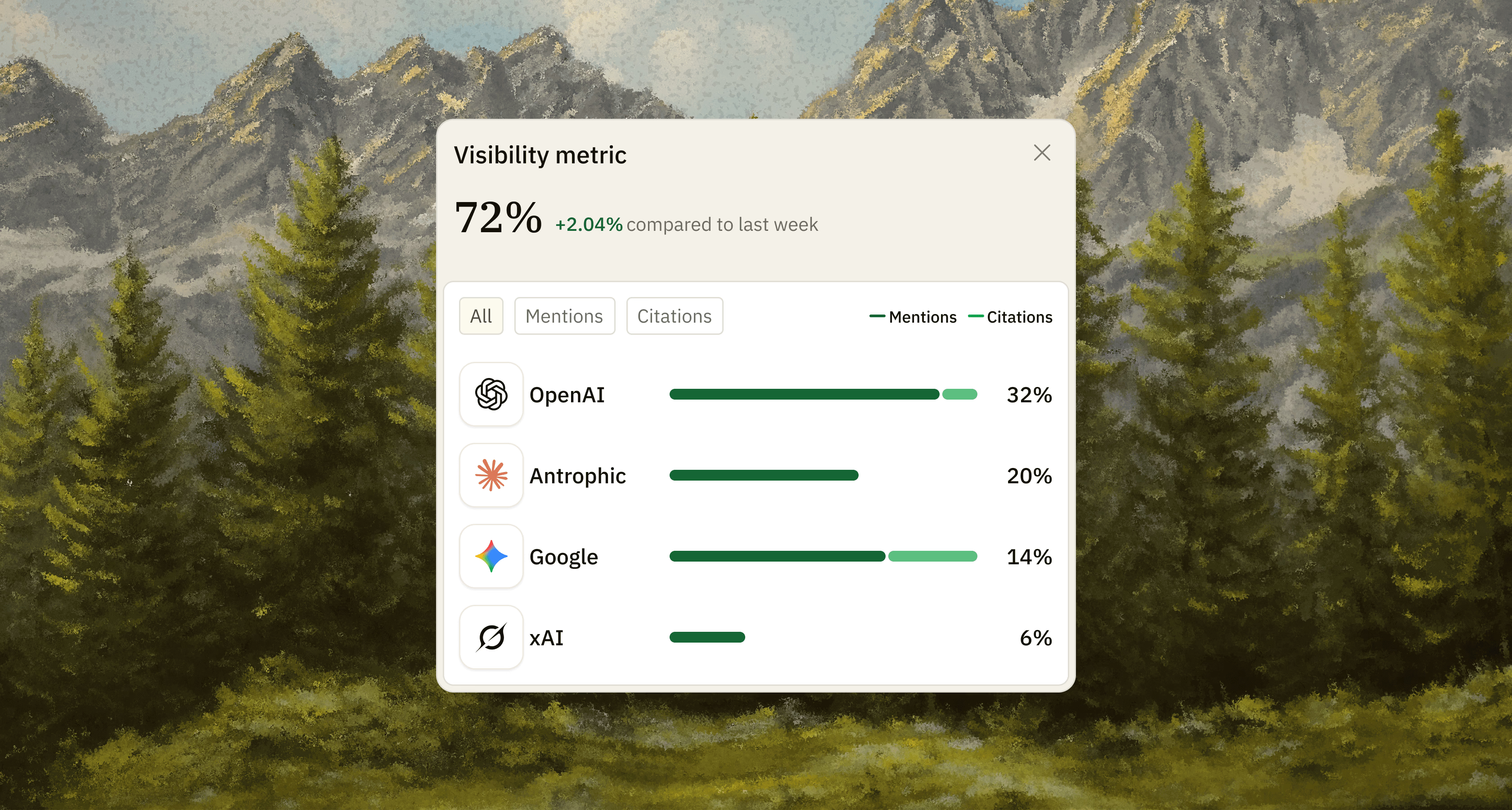
- Inclusion rate in AI answers — Percent of tracked prompts where your brand is a cited source. Studies observed AI Overviews appearing in a non-trivial share of U.S. desktop queries in early 2025, so being inside the answer matters (Semrush).
- Claim-level pickup — Which sentences get quoted. Optimize these for clarity and provenance.
- Time to refresh — Hours or days from source change to published update.
- Citeable coverage — Percent of priority pages with TLDR, atomic claims, tables with captions, inline citations, JSON-LD completeness.
- Answer engagement — Downstream clicks from the answer module to your page; pair with on-page conversions.
External signals also indicate behavior change at the SERP layer: Pew reported users are less likely to click traditional links when an AI summary appears. Similarweb coverage via Digiday notes rising zero-click behavior in news contexts, again highlighting the importance of inclusion and attribution inside answer units.
Track the whole funnel, not just rankings: inclusion → citation → click → conversion.
Governance & ethics
Misinformation & corrections. Treat verifiability as a product feature. Cite primary sources next to claims, maintain an audit trail of edits. If a fact changes, update the claim, the table, and the date—not just the date.
Accessibility. Use semantic HTML, tables with caption, figures with <figcaption>, descriptive alt text, and sufficient contrast. Accessibility improves human experience and clarifies meaning for machines that extract structure.
Bias checks. Sensitive topics need careful framing and balanced sources. Define a source policy—e.g., official standards, peer-reviewed research, recognized institutions—and apply it consistently.
Sustainability. Prefer HTML text to heavy images for key content. Minimize re-render churn. Cache charts when possible and update only when facts change. Efficient publishing can reduce compute while improving user experience.
Freshness is a loop, not a one-off: monitor → correct → publish → measure.
Where Wrodium fits in (the GEO engine)
Wrodium assumes your pages will be read by people and by models. It scans content for claims, aligns each claim with a source of truth, and suggests edits that tighten language, add inline citations, and refresh dates. It validates JSON-LD completeness and sitemap/indexability. Drawing from RAG principles (arXiv) and aligned with Google's people-first and structured-data guidance (helpful content, FAQ schema), it then tracks whether your brand appears as a cited source in AI answers and which sentences were surfaced.
Workflow: Wrodium turns monitoring into action—insights → edits → approvals → live, citeable pages.
References (with context)
- Google — Helpful, reliable, people-first content
- Google — FAQPage structured data
- Google — AI Overviews
- Retrieval-Augmented Generation (RAG) paper — arxiv.org
- Semrush — AI Overviews study
- Pew — Users click less when AI summary appears
- Digiday — Zero-click searches & publisher impact