
AI search is generating revenue for your business right now. A potential customer asked ChatGPT for software recommendations. Your product appeared. They clicked through, converted, and became a paying customer. Your analytics dashboard? Shows them as "direct traffic." You can't measure AI search revenue if your attribution is blind to the channel driving it.
Why Can't Most Companies Measure AI Search Revenue Today?
The fundamental problem is attribution blindness. When someone discovers your brand through ChatGPT and later converts, your analytics assigns that revenue to the wrong channel — or to no channel at all.
This happens through three mechanisms that make AI search revenue invisible:
- Stripped referrer data. ChatGPT and other AI platforms often don't pass referral information when users click through to your site. Those visits show up as "direct traffic" in GA4 — indistinguishable from someone typing your URL from memory. AI Peekaboo's research confirms that self-reported AI attribution consistently runs significantly higher than what GA4 captures through referral data alone.
- Delayed branded search. A buyer sees your brand recommended by ChatGPT but doesn't click the link immediately. Instead, they Google your brand name later — maybe hours or days later. That conversion gets credited to branded organic search. You see brand search volume rising but can't connect it to the AI citation that triggered it.
- Copy-paste behavior. Users copy URLs from AI chat responses and paste them directly into a new browser tab. No referrer, no UTM parameters, no attribution. Pure "direct" traffic that's actually AI-generated demand.
The result: companies are generating meaningful AI search revenue but crediting it to Google, direct, or brand channels. They can't optimize a channel they can't see — and they're making budget decisions based on incomplete data.
Birdeye's research on AI search attribution frames it well: the goal isn't perfect tracking for every AI journey, but better decisions based on AI-aware measurement. That's what this framework delivers.
→ See how Wrodium's Telemetry makes AI-driven citations and revenue impact visible
How Much Revenue Is AI Search Actually Driving?
Between July and September 2025, we tracked AI-referred traffic performance across seven B2B companies using the attribution framework described in this article. The findings reframe everything marketers assume about customer acquisition — and provide a baseline for measuring AI search revenue at your own company.
AI-referred sessions converted at an 18% rate compared to 2.8% for traditional organic search — a 6.4× improvement. Not a marginal lift. Not a rounding error. Six point four times higher conversion on a channel most companies aren't even measuring.
This data aligns with broader industry findings on AI search revenue potential:
- Seer Interactive's analysis of LLM conversion rates found ChatGPT-referred traffic converts at 15.9%, Perplexity at 10.5%, and Claude at 5% — all dramatically outperforming Google Organic's 1.76%.
- Semrush's research confirms the pattern: the average LLM visitor is worth 4.4× more than the average organic search visitor based on conversion rates.
- Similarweb's Global Ecommerce Report found AI referrals converting at 11.4% versus 5.3% for organic across global e-commerce.
- Amsive's analysis showed 56% of sites see higher conversions from AI-driven sessions, with high-traffic sites converting at 7.05% compared to 5.81% for organic.
- Microsoft Advertising reported that Copilot-powered journeys are 33% shorter and 76% more likely to lead to lower-funnel conversions.
The volume is still modest — AI referral traffic accounts for roughly 1% of total sessions for most B2B sites, according to Conductor's November 2025 analysis. But AI-referred sessions grew 527% year-over-year in the first five months of 2025. Gen AI traffic is growing 165× faster than organic search traffic, per WebFX. Gartner projects traditional search volume drops 25% by 2026.
The math is clear: even at 1% of traffic, the revenue impact is substantial when that traffic converts at 6× the rate. And the channel is growing faster than any other.
To estimate your own AI search revenue: Take your current monthly direct + branded organic sessions. Apply a conservative 5–10% assumption for AI-influenced traffic (based on survey data from companies using this framework). Multiply by your average conversion rate for AI-referred visitors (use the industry benchmarks above as a starting point). Multiply by your average deal value. That's your current AI search revenue — invisible in your dashboard but real in your pipeline.
How Do I Set Up AI Search Revenue Attribution in GA4?
To measure AI search revenue, you need three layers of attribution working together: self-reported source data, platform-level tracking, and behavioral proxy signals. Here's the exact setup.
Layer 1: The source survey (add this today — 5 minutes)
Put this question in your sign-up, demo request, or onboarding flow:
"How did you first hear about us?"
☐ ChatGPT · ☐ Claude · ☐ Perplexity · ☐ Google AI Overview · ☐ Google search · ☐ Social post · ☐ Friend or colleague · ☐ Other: _______
This is the single most important step for measuring AI search revenue. Leading SaaS companies like Attio, Wispr Flow, and Framer already use this approach. Self-reported data captures the AI-influenced conversions that platform analytics miss entirely — the delayed branded searches, the copy-paste direct visits, and the stripped referrals. When you compare survey results to GA4 referral data, the gap reveals exactly how much AI search revenue your analytics is hiding.
Layer 2: Custom AI channel in GA4
Follow the GA4 Playbook method: Go to Admin → Channel Groups → Create New Channel Group. Create an "AI Search" channel with a regex filter matching AI referral domains:
chatgpt\.com|perplexity\.ai|claude\.ai|copilot\.microsoft\.com|gemini\.google\.comReorder this channel above "Referral" so it takes priority. This ensures AI traffic is automatically grouped in all your acquisition reports rather than buried under generic referral data. For a comprehensive regex covering dozens of AI tools, see the full pattern from Analytics Playbook.
For ChatGPT specifically, look for the utm_source=chatgpt.com parameter that ChatGPT now appends to citation links. Filter your Traffic Acquisition report by Session Source and search for "chatgpt" to see pages ChatGPT linked to and resulting sessions.
Layer 3: Multi-touch attribution check
Go to GA4 → Advertising → Attribution → Attribution Paths. Change the primary dimension to Source. Look for path lengths of 2+ touchpoints. SUSO Digital found that sessions GA4 credited to "Google Organic" frequently had ChatGPT as the first touchpoint — exposing AI's role as a top-of-funnel discovery channel that generates revenue through other attribution paths.
Layer 4: UTM parameters for AI-optimized content
In content specifically built for AI consumption, add tracking parameters:
utm_source=ai&utm_medium=recommendation&utm_campaign=[assistant_name]&utm_content=[prompt_slug]Example: yoursite.com/solution?utm_source=ai&utm_medium=recommendation&utm_campaign=chatgpt&utm_content=pm-tools-startup
The diagnostic patterns that reveal hidden AI search revenue
| What You See | What It Means | AI Revenue Action |
|---|---|---|
| Brand search up, non-brand flat | AI is driving discovery you can't attribute | Check survey data; compare branded search lift to AI visibility changes |
| Direct traffic to deep URLs | Users pasting URLs from AI chats | Confirm those URLs only exist in AI-optimized content |
| High conversion, low time on site | The compressed AI buyer journey is working | This IS your AI search revenue — optimize speed and reduce friction |
| Demo spike from one segment | AI is positioning you for that specific use case | Double down with segment-specific proof; attribute revenue to AI |
| Citation drop after site update | You removed key GEO-16 signals | Audit schema, FAQs, recency stamps — revenue will follow visibility |
What Metrics Should I Track to Measure AI Search Revenue?
Measuring AI search revenue requires metrics that go beyond traditional analytics. Set up these five GA4 events plus the revenue-specific KPIs to build a complete picture.
Five GA4 events for AI search revenue tracking
- ai_referral_detected — Fires when someone arrives via AI referral (matched by source or AI-specific URL). This is your AI search traffic volume metric.
- use_case_selected — Fires when the visitor identifies with a specific use case on your landing page. This confirms the AI's recommendation matched buyer intent — a leading indicator of revenue.
- micro_conversion — Email signup, demo request, or trial start. This is your primary conversion metric for AI-referred revenue.
- proof_interaction — Fires when a visitor engages with credibility signals (expands a case study, clicks a review link, views a certification badge). High proof interaction with low conversion means your credibility isn't matching the AI's recommendation — you're losing potential AI search revenue at the trust stage.
- faq_interaction — Fires when someone expands FAQ items. Frequent FAQ interaction means the AI's description left questions unanswered — update your content to close those gaps and the AI will incorporate the answers, driving more qualified referrals and revenue.
Five revenue-specific KPIs
- AI-referred conversion rate. Conversions from AI-referred sessions ÷ total AI-referred sessions. Benchmark: 10–18% for B2B SaaS based on our study and Seer Interactive's data.
- AI-influenced revenue. Total revenue from customers who self-reported AI discovery via your source survey. This is your most accurate measure of AI search revenue because it captures the traffic your analytics misses.
- Blended CAC comparison. Compare customer acquisition cost for AI-discovered customers against organic, paid, and other channels. AI-referred customers typically have lower CAC because you're not paying for the click — the AI recommended you organically. Superlines' GEO ROI framework recommends tracking this as a primary efficiency metric.
- AI citation coverage. Count of priority prompts where AI assistants mention your brand, tracked monthly. This is the leading indicator that predicts future AI search revenue. More citations → more referrals → more revenue. Wrodium's Telemetry tracks this as Assistant Share of Voice (SOV).
- Brand search lift. Month-over-month change in branded search volume correlated with AI visibility improvements. Birdeye's research confirms that a steady increase in branded search following stronger AI visibility is one of the strongest proxy signals for AI-driven demand and revenue.
The event patterns tell you where your AI-to-revenue handoff breaks down. Low ai_referral_detected means you're not being cited — focus on authority and freshness signals. High referrals but low use_case_selected means your landing page doesn't match the AI's framing. High use case match but low conversion means trust signals are weak. Each diagnostic points to a specific fix that unlocks more AI search revenue.
Why Does AI Search Revenue Convert at Higher Rates Than Organic?
The 6.4× conversion advantage isn't random. It's a structural consequence of how AI compresses the buyer journey — and understanding this mechanics is essential for anyone trying to measure and grow AI search revenue.
Traditional organic search journey:
A buyer types "best project management tool for startups" into Google. They get 10+ links, open 3–5 tabs, read comparison posts, skim product pages, bounce between options over multiple sessions across days. The funnel is long, leaky, and full of friction.
AI-referred journey:
A buyer asks ChatGPT the same question. In seconds, they get a curated shortlist with feature comparisons, pricing context, and tailored recommendations. They click through to one or two options. They expect the landing page to confirm exactly what the AI just told them. If it does, they convert. If it doesn't, they bounce.
The entire awareness-to-consideration-to-decision journey compresses into a single interaction. By the time someone clicks through from ChatGPT, they've already been pre-qualified by the AI. Their questions are answered. Their objections are addressed. They just need confirmation.
BrightEdge's analysis frames it precisely: AI search functions as a research channel that pre-qualifies buyers who then convert through other channels, often within minutes. Bing's research on AI conversion measurement confirms the pattern: AI-referred visitors move through the conversion path in fewer steps because discovery, evaluation, and comparison happened inside the chat.
What this means for measuring AI search revenue: The traditional funnel model of Search → Click → Evaluate → Convert is being replaced by Prompt → Research → Recommendation → Purchase. Your AI search revenue is concentrated in a compressed, high-intent conversion window. If you're only measuring last-click attribution, you're systematically undercounting the revenue AI search generates — because much of it shows up attributed to other channels.
What Signals Drive AI Search Revenue by Getting You Cited?
You can't generate AI search revenue if AI systems don't recommend you. Understanding the signal clusters that drive citations is essential for growing the revenue this channel produces.
Based on our analysis across seven B2B companies plus published research from Princeton's GEO study, Semrush, and OpenAI's Shopping Research announcement, the signals break into six clusters — with a crucial distinction: citations and conversions require different signals, and both determine your total AI search revenue.
- Authority signals (drive citations → drive revenue). AI assistants weight credentials, third-party validation with proper schema markup, client proof tied to specific use cases, and topical expertise demonstrated through comprehensive documentation. Pages with original data tables earn 4.1× more AI citations, per Princeton's GEO research. More citations mean more referrals, which directly increases measurable AI search revenue.
- Semantic clarity (drives conversions → captures revenue). Clear problem-to-solution framing, explicit feature-to-benefit mapping, and outcomes with context. Content that answers "who is this for" and "why is it good" gives AI strong language to echo in recommendations — and gives visitors the confirmation they need to convert.
- Technical surfaces (drive discoverability → expand revenue). Structured data markup (FAQs, products, organization schema), clear heading hierarchies, and FAQ coverage matching how people prompt AI. Walker Sands' research confirms structured metadata significantly improves LLM visibility.
- Freshness indicators (drive citations → protect revenue). Research shows that pages untouched for over 12 months see citation likelihood drop by more than 50%. Every citation lost is AI search revenue lost. Wrodium's Update Agents keep content fresh on ≤60-day cycles to prevent this decay.
- Trust and safety (drives conversions → closes revenue). Clear security pages, transparent pricing, fast performance, and accessible docs. OpenAI has stated that Shopping Research is trained to read "trusted sites" — trust markers directly impact whether AI-referred visitors convert into revenue.
- Third-party validation (drives both → multiplies revenue). ChatGPT explicitly weights Reddit discussions and independent reviews over brand-owned content. For SaaS, G2, Capterra, and TrustRadius reviews are critical. Authentic third-party mentions increase both citation frequency (more traffic) and conversion confidence (more revenue per visit).
How Do I Build a Landing Page That Converts AI Search Traffic Into Revenue?
When someone arrives from an AI recommendation, they need immediate confirmation they're in the right place. They're not browsing — they're verifying a decision the AI already helped them make. This is where AI search traffic becomes AI search revenue.
Here's the exact template that produced the 6.4× conversion lift in our study:
Hero section (above the fold):
- H1: "Recommended for [exact use case the assistant mentioned]"
- Subhead: "Here's why ChatGPT/Claude/Perplexity suggests us for [specific use case]"
- Proof Bar: ★★★★★ 847 reviews | SOC 2 Certified | Trusted by [relevant logos]
- Primary CTA: "Start free trial" · Secondary: "See 2-minute walkthrough"
The exact fit section (immediately below):
Match the AI's recommendation language to your features. "Consolidate sprint planning and docs" → Two-way sync with GitHub/Jira. "Fast onboarding for non-technical teams" → Role-specific templates ready to use. "Predictable pricing at 20 seats" → Transparent tiers, no forced annual contracts.
Social proof (keep it relevant):
Two to three short quotes from companies matching the visitor's likely profile.
FAQ section (answer like an AI assistant would):
Structure around follow-up questions a buyer would ask ChatGPT after seeing your recommendation. Use FAQ schema markup — it feeds directly back into AI citation loops. Wrodium's Guardrails feature validates your JSON-LD for consistency before anything ships.
Sticky footer: "Book a 15-minute fit check" → Direct to calendar.
This isn't about being clever. It's about confirmation. The visitor already knows what they want — your job is to convert AI search traffic into measurable revenue by confirming they've found it.
→ See how Wrodium's Draft Builder creates structured, schema-ready content
How Do I Implement AI Search Revenue Tracking in 30 Days?
Week 1: Establish your revenue baseline
Add the source survey question to your sign-up and demo forms (5 minutes). Audit where AI assistants currently mention you — test 20–30 prompts across ChatGPT, Perplexity, and Claude. Set up the custom AI channel group in GA4 and the five tracking events. Document current conversion rates and revenue by channel as your baseline.
Week 2: Launch your first AI landing page
Build one AI-specific landing page using the template above, targeting your highest-volume use case. Add structured data markup — FAQ, Product, and Organization schema. Implement UTM tracking in your AI-optimized content. Add authority signals relevant to the use case.
Week 3: Optimize your content for AI citations
Rewrite your top 3–5 pages with problem-solution framing and descriptive H2/H3 headings. Build out FAQ sections with questions matching real AI prompts. Update technical documentation — eliminate any content drift between your product pages, docs, and blog. Wrodium's Update Agents automate this freshness cycle on ≤60-day SLAs.
Week 4: Measure and attribute revenue
Review survey data and GA4 events. Calculate your first AI-referred conversion rate and AI-influenced revenue estimate. Compare AI-attributed CAC against other channels. A/B test your AI landing page. Identify which prompts drive the most qualified traffic and plan expansion.
Start with one page. One survey question. One week of data. Then expand based on what you learn about your AI search revenue.
→ Book a demo to see how Wrodium accelerates AI search revenue measurement and growth
The Bottom Line: You Can't Grow What You Can't Measure
The 6.4× conversion advantage exists because most companies haven't figured out how to measure AI search revenue yet. They're getting AI-driven customers and crediting Google, direct, or brand search. They're making budget decisions based on incomplete data, underinvesting in the highest-converting channel they have.
The industry trajectory is unambiguous: Gartner projects traditional search volume drops 25% by 2026. AI referral traffic grew 527% year-over-year. RankScience estimates AI could drive equal conversions to Google by late 2027. The companies that measure AI search revenue now are the ones who'll know where to invest when that crossover happens.
We've seen this play out: Anqa Life went from zero organic visibility to 956 users and measurable pipeline in 30 days using the GEO infrastructure described in this article.
Wrodium is the content freshness and AI visibility layer for marketing teams that need to measure and grow AI search revenue. Our four pillars — Update Agents, Guardrails, Telemetry, and Draft Builder — keep content cited, track citation-to-revenue impact, and prove ROI on your GEO investments.
→ Book a demo — See how Wrodium measures and grows your AI search revenue
→ Read the Anqa Life case study — From zero to measurable AI-driven pipeline in 30 days
Frequently Asked Questions
How do I know if ChatGPT is already sending me traffic?
In GA4, go to Reports → Lifecycle → Traffic Acquisition. Change the dimension dropdown to "Session source" and search for "chatgpt". You should see chatgpt.com as a referral source. If you see nothing, much AI-referred traffic arrives as "direct" because referrer data gets stripped. Add the source survey to your sign-up flow to capture the full picture of your AI search revenue.
How long does it take to measure meaningful AI search revenue?
The survey question reveals AI-influenced revenue immediately — you'll see results within your first week of data collection. GA4 referral tracking shows direct AI traffic from day one. Passionfruit's research notes that AI SEO ROI typically becomes measurable within 3–6 months of optimization, though initial citation improvements appear within 4–6 weeks. The attribution framework in this article accelerates that timeline significantly.
What's the difference between AI search revenue and AI-influenced revenue?
AI search revenue comes from direct AI referrals — someone clicked a link in ChatGPT and converted. AI-influenced revenue is broader: someone saw your brand recommended, then later converted through branded search or direct visit. Both contribute to total AI-driven revenue. The survey captures both; GA4 referral data captures only direct AI referrals. Bing's research covers this distinction in depth.
Should I stop investing in traditional SEO to focus on AI search revenue?
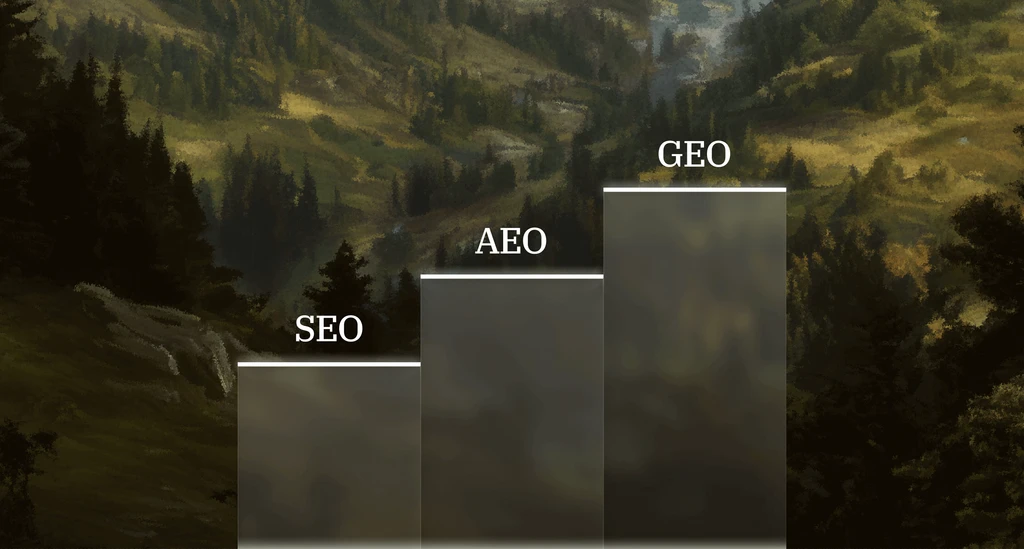
No. AI systems use retrieval-augmented generation (RAG), which queries traditional search indexes before generating answers. Google's John Mueller stated: "There is no such thing as GEO or AEO without doing SEO fundamentals." The optimal allocation for most B2B companies is 70–80% traditional SEO, 20–30% AI optimization. Read our comparison of GEO, SEO, and AEO.
What is generative engine optimization (GEO)?
GEO is the practice of optimizing content to improve visibility in AI-generated answers — being cited by ChatGPT, Perplexity, and Google AI Overviews rather than just ranking in traditional search. The term was introduced by Princeton University researchers in 2023. Wrodium's GEO-16 framework maps the 16 specific signals that determine whether AI systems cite your content. → Learn more about GEO vs SEO vs AEO
How do I measure AI search revenue if I have limited resources?
One survey question. One AI-specific landing page. Two weeks of data. Start with the survey — it takes five minutes and immediately reveals how much AI search revenue your analytics is hiding. For a real-world example of rapid implementation, read the Anqa Life case study.
Sources: Seer Interactive (LLM conversion rates), Semrush (LLM visitor value), Ahrefs (AI visitor behavior), Similarweb (AI e-commerce conversion rates), Amsive (AI vs organic conversion), Conductor (AI referral traffic share), Search Engine Land (AI traffic growth), BrightEdge (AI search analysis), Microsoft Advertising (Copilot data), Gartner (search volume projections), AI Peekaboo (self-reported attribution), Princeton University (GEO research), Bing Webmaster Blog (AI conversion measurement), Birdeye (AI search attribution), RankScience (AI vs Google timeline), Superlines (GEO ROI framework), Passionfruit (AI SEO ROI metrics). Internal data from Wrodium study across 7 B2B companies, July–September 2025.